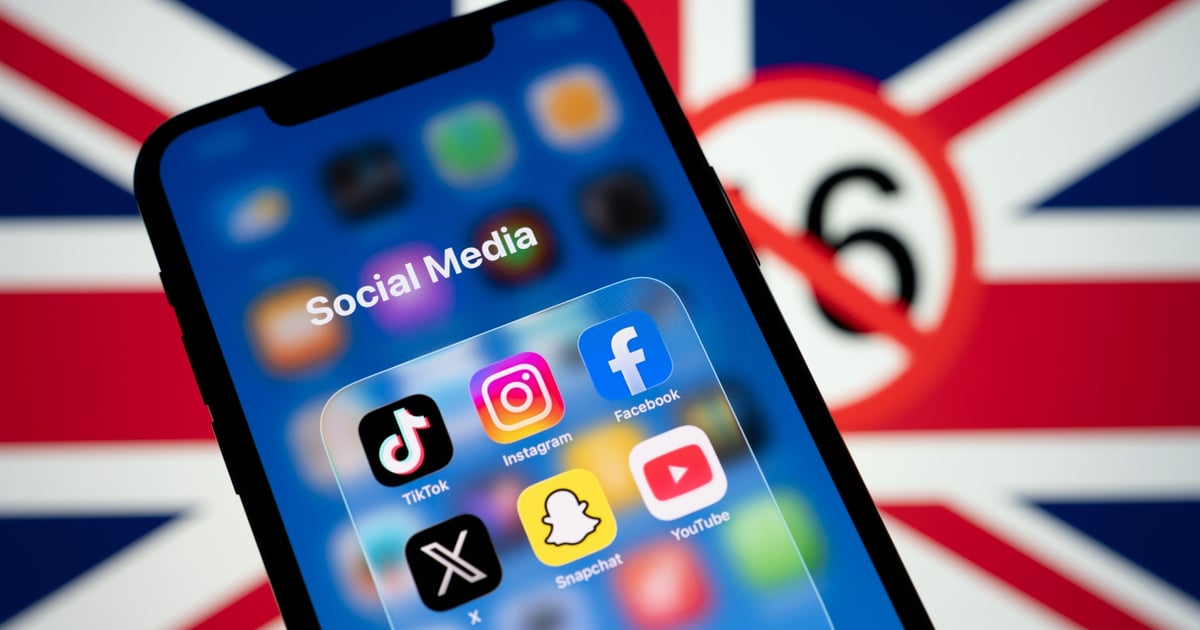
British Prime Minister Keir Starmer said on Monday that the UK will ban adolescents from accessing some social media sites, interacting with certain AI chatbots, and using livestreaming and certain gaming sites, making it the latest developed country to take on social-media companies.
User-to-user platforms — such as Facebook, Instagram, Snapchat, TikTok, X, and YouTube — are the primary target of the ban, which will go into effect in early 2027, the UK government stated. The regulations could include limits on “infinite scrolling” and creating digital curfews for children under 18 to prevent late-night sessions.
Messaging services such as Signal or WhatsApp would not impacted, Starmer said in a statement announcing the effort.
“This is a line in the sand,” he said. “Tech giants had their chance and failed, but we’re stepping in to protect children, back parents and set a new normal for future generations.”
The UK joins a host of other nations determined to limit young users’ access to social media. Last week, Canada introduced legislation that would restrict social media access and place some limits on AI chatbots for children under 16 unless platforms meet certain safety standards. Australia has already implemented such a ban, which went into force in December 2025, barring young users from accessing Facebook, Instagram, TikTok, and YouTube. The leaders of several EU nations — including France, Greece, and Spain — have also called for bans on children’s access to some social media services.
Concern: From Social Media Ban to Surveillance
There remains a robust academic debate over whether social media causes harm to young minds or whether using algorithmic-based services leads to mental distress or if people with mental health issues gravitated toward social media.
For the most part, the matter seems settled in the public’s collective mind. Nearly three-quarters (74%) of adults in Great Britain strongly or somewhat support a ban, according to a YouGov poll. The UK government opened up the issue to public comment — a “consultation” — collecting more than 116,000 responses between this year, with 90% of parents supporting the ban, according to the government’s statement.
The UK is not alone. In two court cases, juries in the US punished social-media firms for their products. One jury handed down a $375 million ruling against Meta, the parent of Facebook and Instagram, saying that the company’s products allowed children to be exploited, while a second jury levied a $6 million penalty against Meta and Google’s YouTube for creating addictive products.
Yet, social media companies and digital-rights activists have pointed out that early data has shown that Australia’s ban has merely shifted kids to using other social networks. In addition, the privacy risks and preventing children’s access to beneficial communities outweigh any protections for children, says Molly Buckley, a legislative analyst with the Electronic Frontier Foundation (EFF), a digital rights group.
“Social media bans weaponize parents’ concerns about children’s safety to justify unprecedented levels of surveillance and censorship,” she says. “In the process, these laws deny young people their rights, threaten our online anonymity, expose our sensitive personal data to breach and abuse, and replace parental decision-making with state authority.”
In March, social-media network Discord faced criticisms for instituting age checks, because the firm suffered a data breach the previous October that exposed tens of thousands of government IDs.
Age Verification Raises Host of Security Issues
Verifying age online is a hard problem. Such bans raise the sticky technology question of how to determine a user’s age while protecting their privacy, says Jillian Kossman, chief operating officer of IDScan.net, an identify-fraud prevention firm.
“The blanket bans on social media in Australia and now the UK are a sign that authorities aren’t confident in the ability to accurately verify the age of users and adjust their access to certain platforms accordingly where they’ve instead opted to shut the doors entirely,” she says.
A survey of Australian parents and their kids, for example, revealed that neither the age verification technology nor social media firms’ enforcement have been effective. Only about a third (31%) of under-16 kids have had their faces scanned for age verification and about half of those passed the test.
Joe Kaufmann, global head of privacy and data protection officer at Jumio, an identity-verification service, notes that technology does exist to provide privacy-enhanced checks and limit the possibility of breaches of sensitive information — but the stakeholders have to prioritize those capabilities.
“Balancing confidence, coverage, and privacy is the hardest part to get right,” he says. “Many minors do not have access to traditional identity documents, which means platforms need age assurance options that are both accessible and proportionate. No single method solves every use case, so organizations must determine the appropriate level of assurance for their risk profile while minimizing friction for legitimate users.”
Choosing to put privacy at even greater risk for dubious protection is how digital rights are slowly taken away, says Buckley of the EFF.
“Overall, it’s a lose-lose scenario: either platforms collect new forms of our most sensitive and immutable data, or they unleash their AI and algorithms on our existing behavioral data to make creepy guesses about who we are and what we deserve to see,” she says. “If we don’t trust tech companies with our private information now, we shouldn’t pass laws that force us to give them even more of it.”
Comments are closed